This speech was delivered by Assistant Director Ruby de Guzman during the launch of People of Asia for Climate Solutions and New Energy Nexus-Philippines' joint study, “Bridging Opportunities: A Roadmap for China-Philippines Renewable Energy Collaboration.”
Good afternoon everyone! The Department of Energy would like to thank the organizers for the invitation to the launch of their report, “Bridging Opportunities: A Roadmap for Philippines-China Renewable Energy Collaboration.”
The Philippines is an emerging investment destination and it is a promising renewable energy (RE) growth market in the region. Actually, last year, the Philippines is second in terms of RE investment destination globally and that's as reported by the Bloomberg New Energy Finance.
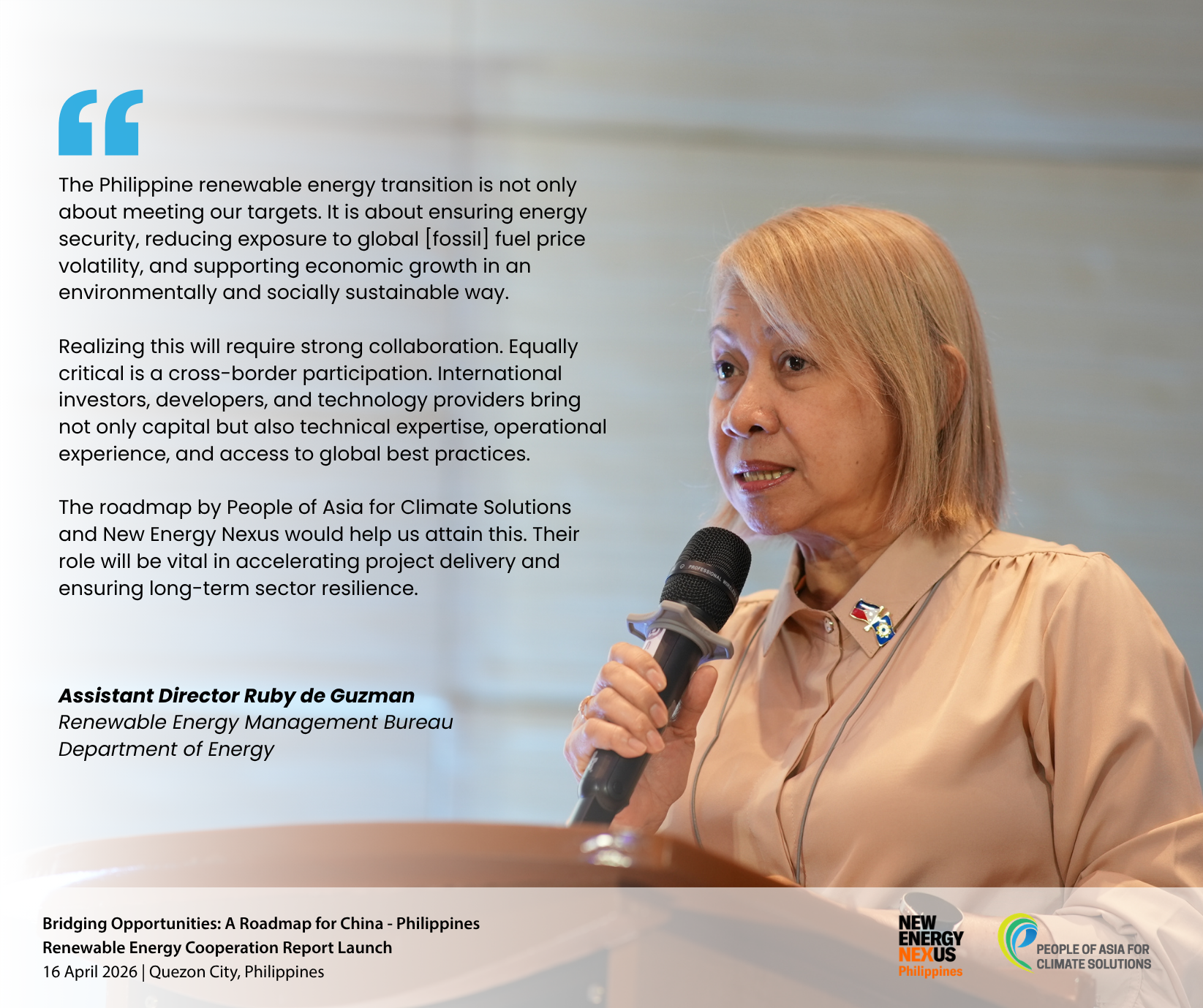
Assistant Director Ruby de Guzman delivering the keynote message during the launch of “Bridging Opportunities: A Roadmap for China-Philippines Renewable Energy Collaboration on
April 16, 2026 in Quezon City, Philippines.
With our abundant solar, wind, biomass, hydro and geothermal resources, the country is uniquely positioned to transition toward a cleaner, more secure and more sustainable energy future. And this opportunity is reinforced by our strong energy demand outlook. As our economy expands and our population grows, electricity demand is expected to rise steadily in the coming years.
Meeting this demand will require not only additional capacity but capacity that is reliable, affordable and sustainable. And RE is central to achieving all three of this. By the end of 2025, renewable energy accounted about 25.4% of the country's gross energy generation. It's up from 22.2% in 2024. So there's about 3.2% increase. This is an important milestone and we are looking at reaching our target of 35% renewable energy share in the power generation mix by 2030.
This progress signals renewed momentum but also underscores the urgency of accelerating renewable energy deployment at scale. To drive this growth, the Philippines has established one of the most comprehensive renewable energy policy frameworks in the region. At the core is the National Renewable Energy Program, supported by market-based mechanisms designed to create sustained demand and investor confidence.
The key policies under the renewable energy law are the Renewable Portfolio Standards and the Green Energy Auction (GEA) Program. These policies have been instrumental in mobilizing investments and accelerating capacity additions. The RPS mandates all load-serving entities to have a portion of their supply coming from renewable energy sources, while the GEA is a competitive bidding program to ramp up the country's renewable energy capacity.
We will continue to build on this momentum with additional auction rounds for various RE technologies. Last February 14, we launched or the DOE has announced its 10-year GEA plan with an indicative capacity of 25 gigawatts. These capacities will have to deliver power between 2027 to 2035.
We will be coming up with announcements in the coming weeks to highlight what are the specific GEA rounds that we will be offering, particularly in support of the demand growth in Visayas and Mindanao. We are also looking at this agri-solar, solar on canals, and solar on stilts. So we are in partnership with the Department of Agriculture, the Department of Agrarian Reform, and the National Irrigation Administration.
On the demand side, programs such as the Green Energy Option Program and Net Metering are empowering consumers to actively participate in the energy transition. These initiatives are making RE more accessible while strengthening market-driven adoption. Earlier this year, the DOE issued amendments to the Green Energy Option Program and the Net Metering Program.
So the amended GEOP lowered the threshold from 100 kilowatts to 50 kilowatts and allows the aggregation of electricity demand from multiple facilities under a single entity. On our Net Metering, the qualified end-user will now be allocated with renewable energy certificates while exported generation will be allocated to the distribution utility. Under the multi-site and aggregate net metering mechanism, a qualified end-user may share or allocate excess net metering credits across multiple electricity accounts registered under the same entity and located within the same DU franchise area.
At the same time, we have undertaken significant policy reforms to improve the investment climate. This includes streamlining the process for securing renewable energy service contracts and notably allowing up to 100% foreign ownership in the exploration, development, and utilization of indigenous renewable energy resources. This landmark reform sends a strong signal that the Philippines is open for business and ready to welcome global capital and expertise.
We have also operationalized the renewable energy market, enabling the trading of renewable energy certificates and further deepening market transparency and participation. So these efforts position the Philippines as a highly attractive destination for renewable energy investment, particularly at a time when global capital is actively seeking scalable and bankable clean energy opportunities. However, realizing this potential will require strong collaboration.
The scale of investment needed, combined with long project development timelines, means that the private sector participation is not just important, it is indispensable. We must continue to unlock financing, the risk investments, and foster innovation through public-private partnerships. Equally critical is a cross-border participation.
International investors, developers, and technology providers bring not only capital but also technical expertise, operational experience, and access to global best practices. This roadmap by People of Asia for Climate Solutions and New Energy Nexus would help us attain this. Their role will be vital in accelerating project delivery and ensuring long-term sector resilience.
We also recognize key challenges that must be addressed. First, we have grid infrastructure that remains a major constraint, with some projects facing delays due to limited transmission capacity. As more variable RE comes online, strengthening and modernizing the grid becomes even more urgent.
In response, the government is advancing a smart and green grid plan to ensure clean energy is delivered efficiently and reliably across the country. Unfortunately, the Philippine RE transition is not only about meeting our targets. It is about ensuring energy security, reducing exposure to global fuel price volatility, and supporting economic growth in an environmentally and socially sustainable way.
With progressive policy reforms and deepening collaboration among the government, the private sector, and international partners, the Philippines is well on its way to becoming a leading RE growth market in Asia. We look forward to the launch of the “Bridging Opportunities: A Roadmap for China-Philippines Renewable Energy Cooperation.” Thank you to the People of Asia for Climate Solutions and New Energy Nexus Philippines for the invitation to grace your event.
On behalf of Secretary Sharon S. Garin, we thank you for your kind attention and good afternoon everyone.
Read and download the full report: https://www.paaacs.org/ReportCenter/Bridging_Opportunities