Private Chinese investment in Indonesian captive coal remains the biggest risk to undermining Beijing's 2021 overseas coal pledge.
HELSINKI / BEIJING, 24 September 2026 - In the five years since China’s pledge that it would stop building new coal-fired power projects abroad and step up support for green energy development, 67% of the overseas coal power capacity planned at that time has been cancelled. Cancellation of China-linked coal power projects has avoided 6.4 billion tonnes of lifetime CO₂ emissions. That's according to the latest annual assessment of China's overseas coal projects by the Centre for Research on Energy and Clean Air (CREA) and People of Asia for Climate Solutions (PACS).
At the same time, operational China-linked renewable energy generation has grown significantly, already surpassing the potential generation of cancelled coal projects in Brazil, Tanzania, and the United Arab Emirates (UAE). As of July 2026, 69.4 GW of China-linked renewable energy projects and 3.3 GW of nuclear power are operational overseas.
Despite progress, the ban has yet to reach full implementation — while 7.1 GW of China-linked coal power capacity was cancelled in 2025, 3.3 GW entered construction, and 20.5 GW remains in planning without official cancellation, together representing roughly 3 billion tonnes of potential lifetime CO₂ emissions.
Since 2021, 5.9 GW of China-linked coal power projects that were not already under construction when the pledge was made have come online, and 7.3 GW entered construction after the ban. Indonesia leads on operational Chinese-linked coal projects (17.1 GW), followed by Vietnam (3.8 GW) and Pakistan (3.4 GW). Most under-construction capacity is in Indonesia, followed by India and Zimbabwe.
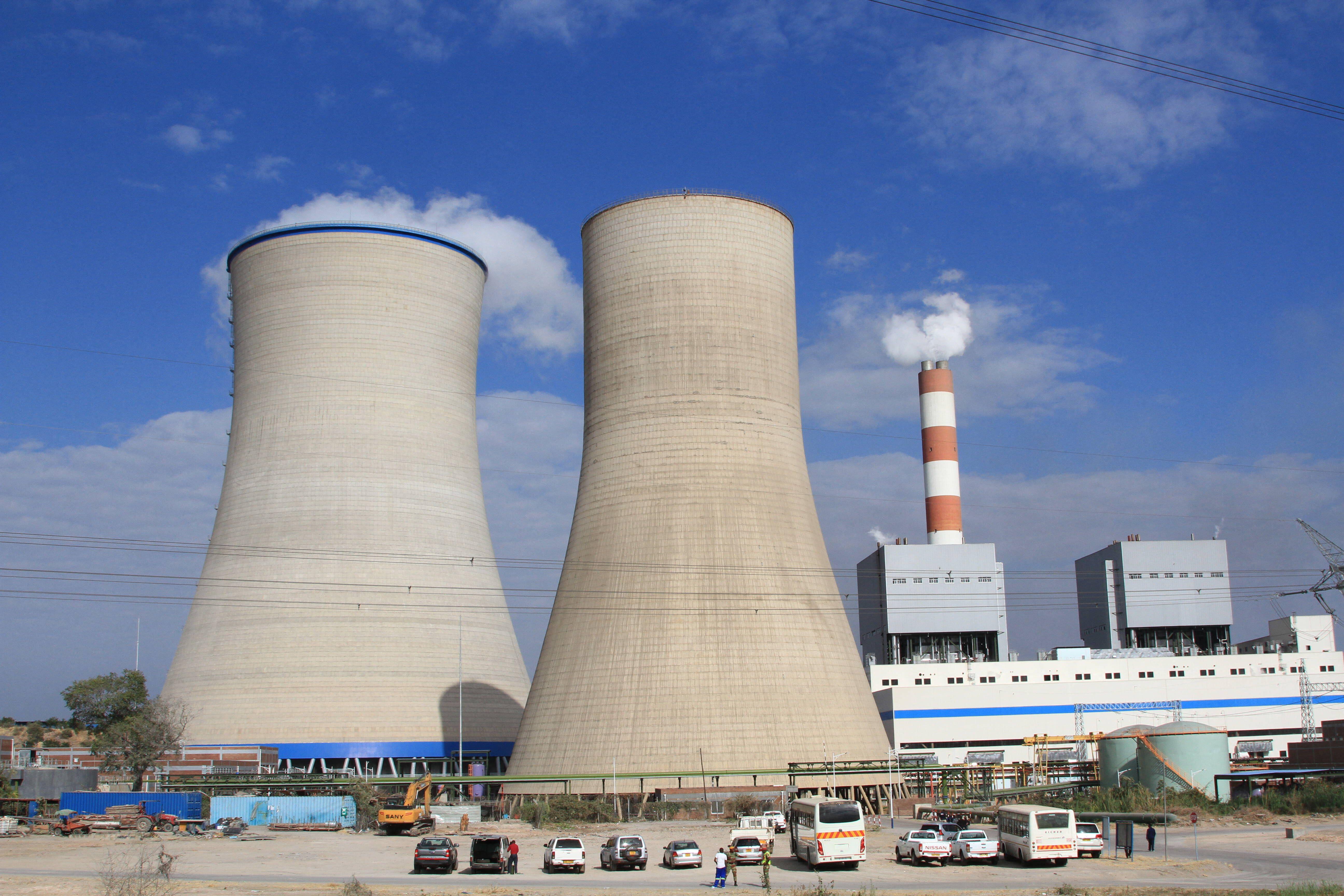
IMAGO/Zhang Baoping. Hwange Thermal Power Station in Hwange, Zimbabwe.
Of this capacity, off-grid, captive coal power plants make up the majority of worldwide operational units, with 60% entering operation and 42% under construction since 2021. Most captive projects are funded by private Chinese companies and linked to mineral-processing and industrial parks in Indonesia, which is home to 94% of overseas China-linked operational captive capacity.
The report’s findings come at a significant moment for China’s green development, with the nation recently rolling out a broad 15th Five-Year Plan (FYP) policy package, and the Council for International Cooperation on Environment and Development (CCICED) Annual General Meeting being held in late September. To demonstrate its position as a responsible power and major contributor to global climate action, China should work with partner countries to:
Immediately cancel or repurpose all coal projects overseas that have not yet started construction while developing retirement and renewables replacement pathways for operational projects.
Address the captive coal power loophole by implementing the pledge on captive coal projects, alongside integrating renewables into existing overseas industrial parks, and developing new zero-carbon industrial parks.
Strengthen governance of the pledge by designating a specific governance body to oversee compliance, while strengthening transparency and accountability.
Maximise the opportunities presented by renewable energy: replacing coal with renewables will support climate goals, electrification, energy security, and the global transition.
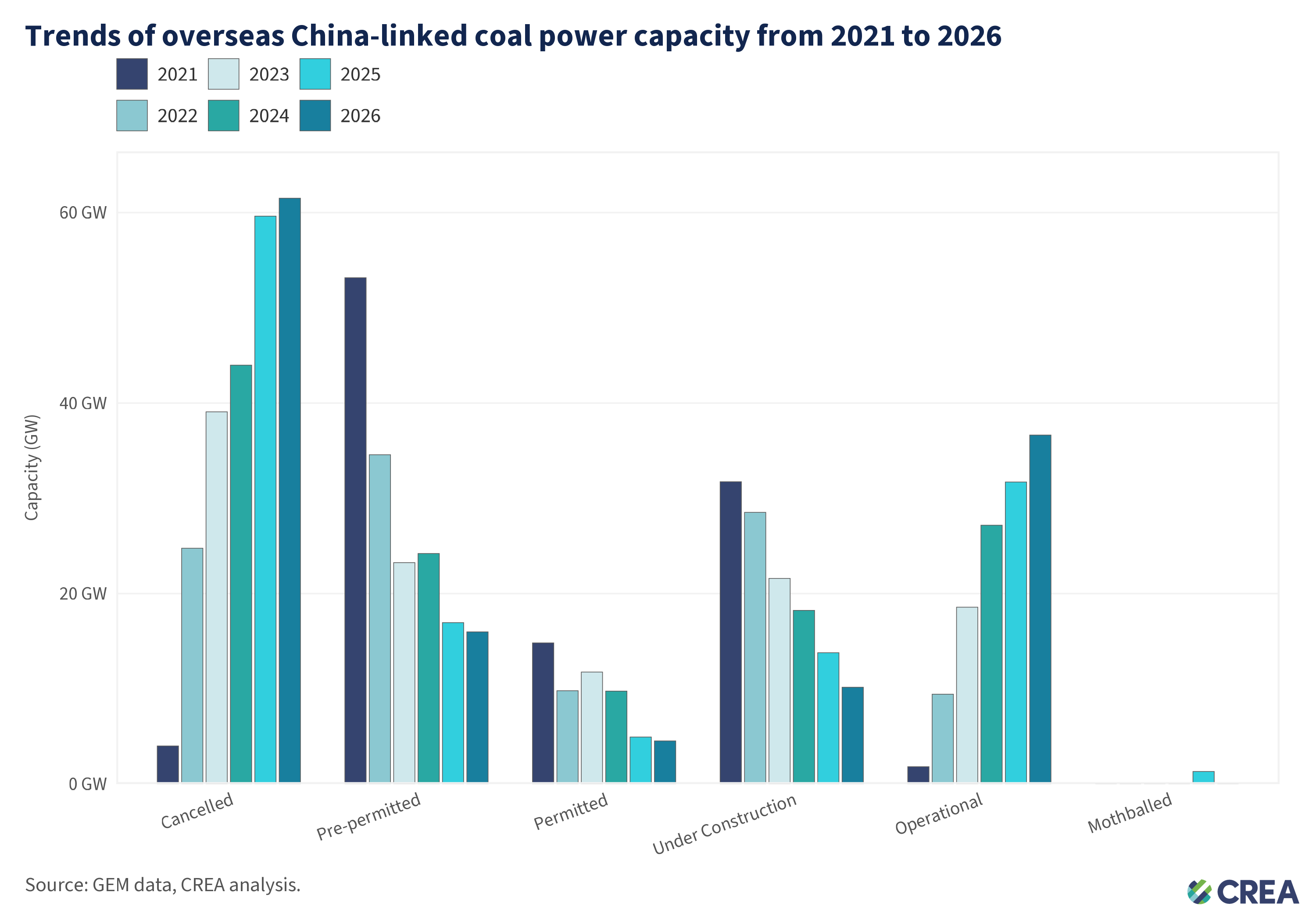
Figure — Trend of overseas China-linked coal power capacity from 2021 to 2026
‘While Chinese state-owned enterprises and banks have made significant progress on the government’s commitments on both overseas coal shutdowns and increased renewable development, the plants still planned or under construction reveal significant gaps in the implementation of President Xi’s pledge. To realise China’s promise to deepen South-South climate change cooperation, the nation must work closely with host countries to convert or cancel the remaining coal pipeline before construction starts and support a stable transition towards non-fossil power sources,’ said CREA China Analyst Lizzie Frost.
‘Indonesia’s energy infrastructure is a split system — amid efforts to restrict new coal-fired power on the national grid, electricity demand driven by industrial policy results in the building of massive amounts of captive, off-grid coal power, much of which is funded by private Chinese companies. Rather than align directly with host-country policy signals, China should apply its domestic plans to speed construction of zero-carbon industrial parks overseas, such as in Indonesia, to reduce local reliance on captive coal generation and truly build “a community with a shared future for mankind”,’ said CREA Analyst, Katherine Hasan.
'Despite great progress on China's overseas coal ban, some Chinese companies continue to participate in overseas projects as contractors, equipment suppliers, or service providers, particularly in captive industrial projects. When commercial interests take precedence over China’s broader green development commitments and the world’s climate security, the benefits of China’s remarkable clean-energy leadership are undermined. China now needs a strong, dedicated government mechanism with the authority to ensure individual companies' actions overseas are fully aligned with the country’s global green commitments. The world should be able to see China’s renewable-energy leadership not only in what it builds, but also in what it chooses not to build,' said People of Asia for Climate Solutions Executive Director, Xiaojun Wang.
Contacts:
Lizzie Frost
China Analyst
Centre for Research on Energy and Clean Air (CREA)
lizzie@energyandcleanair.org
Katherine Hasan
Indonesia Analyst
Centre for Research on Energy and Clean Air (CREA)
katherine@energyandcleanair.org
Leovy Ramirez
Communications Officer
People of Asia for Climate Solutions (PACS)